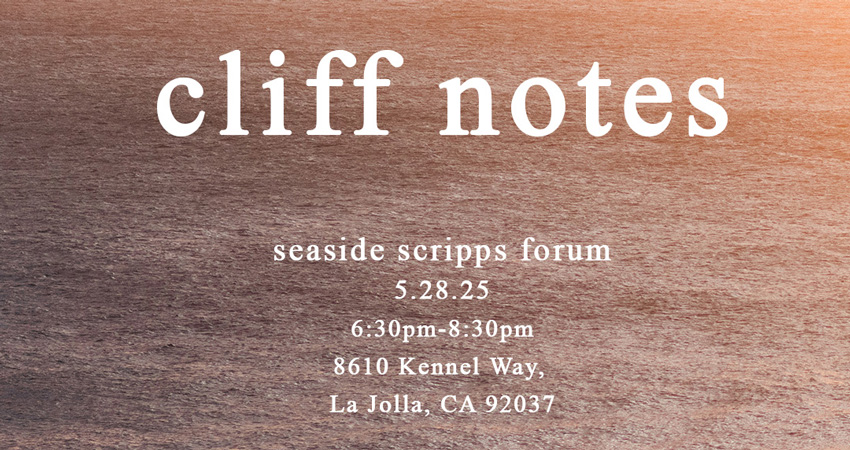
"Thinking quantitatively about nutrient (co)limitation"
Talk Summary: TBD
Coffee and snacks provided!
"Thinking quantitatively about nutrient (co)limitation"
Talk Summary: TBD
Coffee and snacks provided!
"Shell Yeah! Status of wild oyster populations and their restoration in southern California"
Talk Summary: TBD
Coffee and snacks provided!
"Is Anoxia a Hoax? Evidence for Widespread 'Dark Oxygen' Production in Earth's Hidden Ecosystems"
Talk Summary: TBD
Coffee and snacks provided!
"Acropora cervicornis as a model for understanding plasticity's role in ecology and evolution"
Talk Summary: TBD
Coffee and snacks provided!
"Using Microbiomes as Microsensors to Forecast Harmful Algae Blooms: A Multi-omic Approach"
Talk Summary: TBD
Coffee and snacks provided!
Join us on February 5th from 11:30am-12:30pm at the Scripps Seaside Forum for this edition of the Institutional Seminar. We will be featuring the following speakers and their work, and enjoying pizza and conversation afterwards!
Sarah Allard, PhD
Short talks from UCSD graduate students!
Talk titles and summaries TBD
Coffee and snacks provided!
"Co-design for research projects: Benefits, hurdles, and strategies for success"
Talk Summary: "Translational Ecology presents a call for ecologists to effectively translate and mobilize their research into significant action with an emphasis on encouraging cross-disciplinary partnerships to facilitate effective management and policy outcomes. One way to fully leverage those partnerships is through co-designed research, wherein projects are planned and carried out with significant input from individuals…
"Temperature, Traits, and Trophic Interactions"
Talk Summary: "Understanding how mass and energy move between organisms, such as from resources to consumers, and how these local-scale interactions unite to drive and stabilize patterns at the population and community levels is a major goal in ecology. Biological scaling theory tries to quantify and explain how biological rates and times (e.g., metabolic rate, growth rate, and lifespan) depend on individual body size and temperature. Consequently, it holds promise for making general ecological…
"Resolving trophic interactions and energy channels in marine and aquatic ecosystems using amino acid isotope analysis"
Talk Summary: Ecosystems are connected by reciprocal transfer of nutrients and energy. These “nutrient subsidies” move across ecosystem boundaries, for example, from the ocean to the shore or between lakes and surrounding land, and they play a key role in supporting primary and secondary production. In nutritional symbioses, such as corals and their endosymbiotic algae, nearshore production in the form of…